
What WNC Students Say Has Changed Since Hurricane Helene and What It Means for Schools
Insights from the WNC Resilience Project Spring Convening student panel

What students shared offers a clear direction for schools. Maintain high expectations while designing more opportunities for students to connect, lead, and contribute in ways that matter.
At the WNC Resilience Project Spring Convening, six students joined us for a panel: three high school students from the Land of Sky P20 Council Student Ambassadors and three 7th grade students from Evergreen Community Charter School. Over approximately forty minutes, Brian Randall, Western Regional Manager of NC Center for Resilience and Learning, asked four questions: How has school changed since Helene? What helps? What do schools try to do that doesn’t work? What would you change? The goal was to listen closely to how students are experiencing school right now.
What came through was that students are still navigating the impact of Hurricane Helene. They spoke about loss, disruption, and the ways their communities were affected. At the same time, they described how the experience changed the way people showed up for each other. One student described it as an opportunity. Not in a way that overlooks what happened, but in terms of what they saw in others and in themselves. They talked about returning to school more thankful for their teachers and more ready to learn.
This matters at a time when dominant narratives about learning loss and apathy are inviting responses that lean toward rigidity, rather than building on student strengths and agency. What students shared points to a more complete story. The story of this region is one of hardship, and it is also one of strength, connection, and innovation. Students are adapting, contributing, and growing in ways that should shape how schools respond moving forward.

In some cases, the storm leveled roles. Students on the panel found themselves working alongside adults to solve real problems. Adults in their community, including teachers, were seen as people, not just authority figures, and students were trusted as capable contributors.
That perspective carried into how they described school. Relationships came up again and again, but one example captured it clearly. One student shared, “my chemistry teacher is also my bus driver and my barber, I am not afraid to say he's my friend. His class is my favorite subject.” When that kind of relationship is present, students engage, take risks, and push through challenges. The relationship is not separate from the learning. For many students, it is what makes the learning possible.
Students were just as clear about what does not work. One learner named a pattern that shows up when adults respond to hardship by lowering expectations in an effort to be supportive. From their perspective, that misses the mark and leaves them feeling less prepared outside of the classroom.
This student pointed toward approaches often described as mastery based, standards based, or competency based learning. While these models vary, they share a core idea. Students are supported until they reach a clear, meaningful standard, rather than being moved forward with gaps in understanding.
These approaches support engagement and resilience because expectations stay high while the path becomes more flexible. Learning is made visible, progress is tracked over time, and students are given the support they need to actually reach the standard.

Several panelists spoke directly about support systems, especially around counseling and social emotional wellbeing. Students noted that counselors are doing their best with large caseloads. As users of the system, these students pointed to the same systemic challenges that educators and counselors would name.
A related thread that came through was how students connect with each other. They spoke about the value of clubs and spaces built around shared interests, not just future careers. While workforce pathways matter, focusing only on future jobs does not always spark engagement. What they described instead was a space to come together around the things they do, to build relationships across grade levels, and to support and mentor one another when times get tough.
When the conversation shifted towards curriculum and learning, a student stressed the importance of having opportunities to lead, to make decisions, and to take on meaningful responsibility. Following disruption, learning that is hands-on, relevant, and connected to their lives makes a difference.
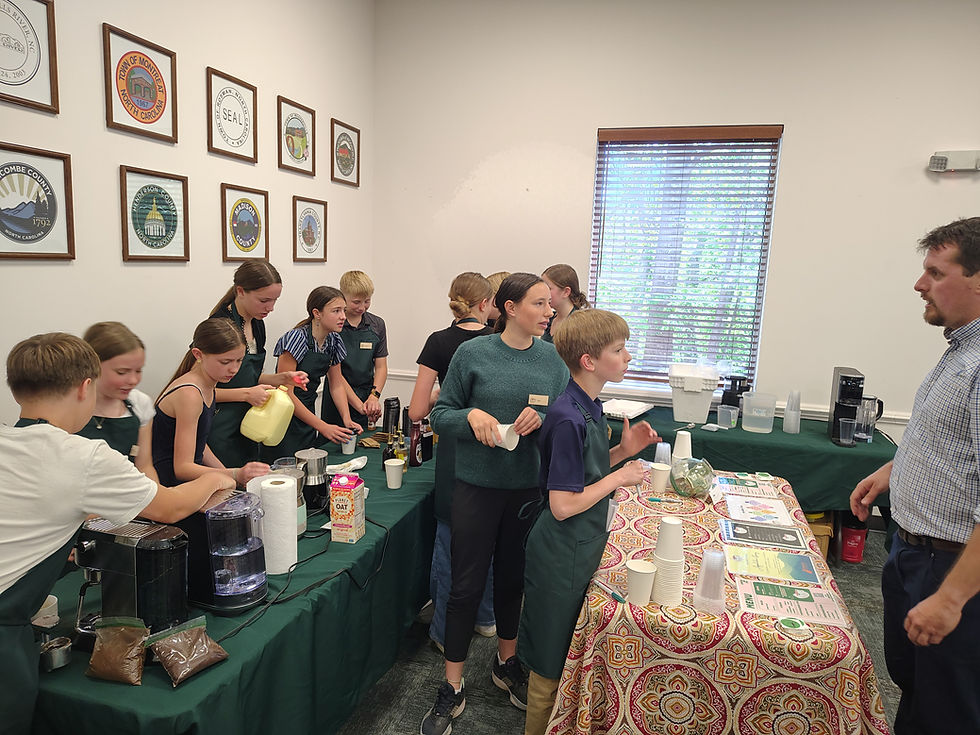
Half of the students on the student panel were part of the Coffee on 7th project, which catered custom coffee drinks and sodas for the Spring Convening. They pointed to this work as an example of learning that helped them contribute to their community and grow as a leader.
As the remaining three hours of the 2026 Spring Convening was a working session for school and district teams, student insights like this one did not stay in the panel. They carried directly into the breakout sessions that followed.
For example, teachers in Madison County worked on ways to support their students as leaders as they organized a thrift fashion show to raise money for a local non profit. In McDowell County, science teachers across multiple schools are collaborating on a project that invites students to contribute by designing ways to sustain the Catawba River and sharing those with the community.

Taken together, what students shared points to a clear direction for schools. Maintain high expectations while providing the support students need to meet them. Invest in relationships as a foundation for learning. Create more opportunities for students to lead, connect, and contribute in meaningful ways. This is the kind of work the WNC Resilience Project is designed to support, strengthen, and scale.
Looking ahead, the 2026 Summer Convening, scheduled for late July, will bring educators, students, and partners back together to reflect on the bright spots from this school year, listen to what students are telling us, and identify the changes we can make moving forward. Participants will connect across districts impacted by Hurricane Helene, engage with community partners, and build networks of support to move emerging ideas forward. Together, this work continues as a shared effort to shape the story of Western North Carolina in the wake of Hurricane Helene.
The WNC Resilience Project is supported by the Leon Levine Foundation and Dogwood Health Trust.


Comments